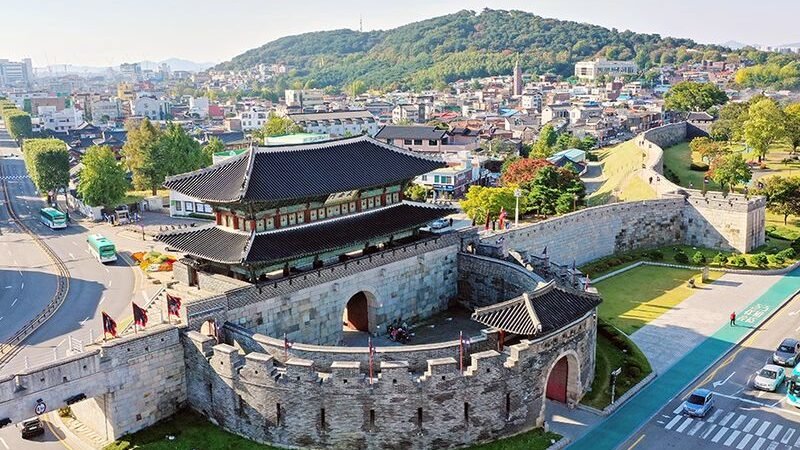
Quick answer: Yes—Suwon Hwaseong Fortress is one of the easiest historic day trips from Seoul. The UNESCO-listed fortress is about 5.74 km long, surrounds Suwon’s old city center, and combines royal history, fortress walls, Hwaseong Haenggung Palace, viewpoints, cafés and restaurants in one walkable district. For a first visit, allow 5–7 hours in Suwon rather than trying to rush the entire wall.
A good first-timer route is Hwaseong Haenggung → Paldalsan/Seojangdae → Hwaseomun → Janganmun → Hwahongmun → Banghwasuryujeong → Haenggung-dong. You get the palace, the best elevated view, major gates, the prettiest waterside section and the café neighborhood without treating the day like a 5.74-km endurance walk.
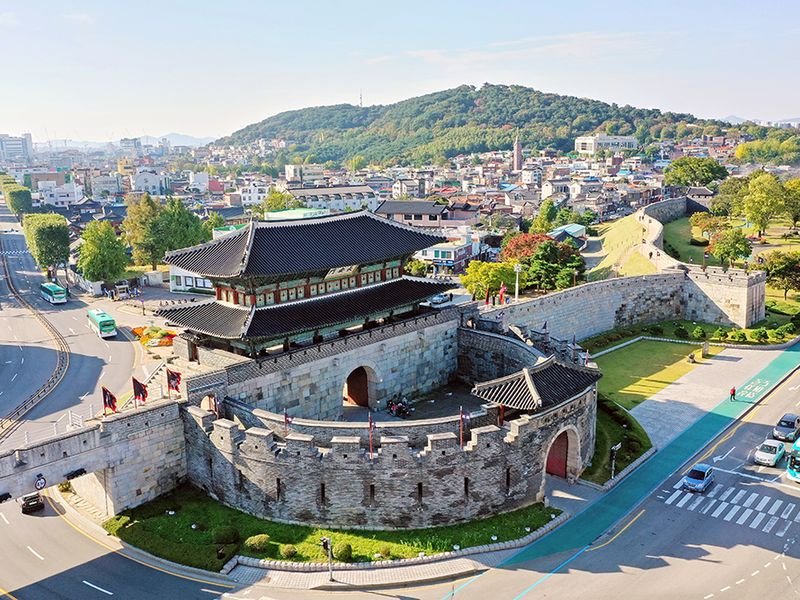
Why Suwon Hwaseong is worth a day trip from Seoul
Hwaseong is not a single palace or a reconstructed tourist village. It is a late-Joseon fortress integrated into a modern Korean city. UNESCO describes its walls as 5.74 km long, enclosing roughly 130 hectares, with four main gates and a sophisticated system of bastions, observation posts, artillery towers and other defensive structures.
King Jeongjo ordered the fortress built from 1794 to 1796. It combined Korean fortification traditions with military and engineering ideas from China and the West. Hwaseong was inscribed on the UNESCO World Heritage List in 1997.
How much time do you need?
If you only want Hwaseong Haenggung and nearby streets, three to four hours can work. For the route in this guide, plan roughly five to seven hours, including lunch or a café stop. Walking the full fortress wall is possible, but it is not necessary on a first visit.
The western section climbs Paldalsan, so the route feels more demanding than its distance suggests. Comfortable shoes matter more here than at a flat palace complex in central Seoul.
How to get to Suwon Hwaseong from Seoul
There are two practical strategies: travel to Suwon Station first and continue by local bus or taxi, or use one of the direct intercity buses from parts of Seoul.
From Suwon Station
Suwon Station is served by Seoul Subway Line 1 and the Suin-Bundang Line as well as rail services. The fortress is not directly outside the station. Suwon’s official tourism guidance lists several local buses from the station to Hwaseong Haenggung, including routes from exits 4, 7, 9 and the transfer center. For a first-time foreign visitor, a taxi from Suwon Station to Hwaseong Haenggung is often the simplest final leg.
Direct from Gangnam, Jamsil or Sadang
Suwon’s tourism office also lists direct bus options from Seoul. From Gangnam Station, bus 3000 serves the Paldalmun area. From Jamsil, bus 1007 reaches the Hwaseong district. Routes from Sadang can also connect toward the fortress area. Bus routes can change, so verify the route in Naver Map or KakaoMap on the day you travel.
If Korean navigation apps are new to you, use KriMind’s Naver Map Guide for Tourists before the trip.
Stop 1: Hwaseong Haenggung Palace
Start at Hwaseong Haenggung, the royal temporary palace at the center of the historic district. King Jeongjo used the palace during visits to Suwon, including journeys connected with his father’s tomb. In 1795, a major banquet celebrating the 60th birthday of his mother, Lady Hyegyeong, was held here.
The current official hours are 09:00–18:00, with final admission one hour before closing. Adult admission is currently ₩2,000. The palace is open year-round.
Do not confuse palace admission with the fortress itself: walking Suwon Hwaseong Fortress is free. The palace is the ticketed attraction.
2026 night opening: a reason to stay after sunset
In 2026, Hwaseong Haenggung’s seasonal night opening runs from May 1 through November 1 on Fridays, Saturdays, Sundays and public holidays, subject to operational changes. Night-opening hours are 18:00–21:30, with final entry at 21:00. The regular adult admission is ₩2,000.
If your visit falls on a night-opening date, consider reversing the usual plan: explore the walls and Haenggung-dong in daylight, eat dinner, then enter the palace after dark.
Stop 2: climb Paldalsan to Seojangdae
From the palace area, climb the western fortress toward Seojangdae, the western command post. This is the steepest part of the suggested route, but it gives you one of the best elevated views over Suwon.
The climb also makes the fortress’s design easier to understand. Hwaseong follows both flat ground and the slopes of Paldalsan rather than forming a simple geometric wall. UNESCO specifically highlights how the fortifications follow the surrounding topography.
Stop 3: walk toward Hwaseomun
Continue along the wall toward Hwaseomun, the western gate. This section lets you experience the ramparts as an actual defensive system rather than viewing isolated monuments from street level. Look for changes in wall height, firing positions and defensive structures as the terrain descends.
Stop 4: Janganmun, the north gate
Janganmun is one of the four principal gates and one of the most impressive structures on the circuit. UNESCO describes Janganmun and Paldalmun as monumental two-story wooden gates built on stone bases and protected by semicircular defensive walls.
This is also a good point to shorten the route if someone in your group is tired. The area is connected to buses and the old-city streets, so you do not have to complete the entire fortress circuit.
Stop 5: Hwahongmun and Banghwasuryujeong
From Janganmun, continue toward Hwahongmun, the northern floodgate where Suwoncheon passes through the fortress. Nearby Banghwasuryujeong, also known as Dongbukgangnu, sits above the water and is one of the most photogenic parts of Hwaseong.
If you only have time for one relaxed scenic section after the palace, this northeast corner is an excellent choice. It combines fortress architecture, water, trees and views without the steeper Paldalsan climb.
Stop 6: Haenggung-dong
Finish around Haenggung-dong, the neighborhood surrounding the palace and fortress. Historic walls sit beside cafés, small shops, restaurants and residential streets, which is exactly why Suwon works well as a day trip: you can move between heritage and ordinary contemporary Korea without traveling to another district.
Do not schedule every hour. Leave at least an hour for wandering, coffee or dinner. That flexibility becomes especially useful around sunset.
Should you walk the entire 5.74 km fortress?
Only if walking the wall itself is one of your main goals. The full circuit is rewarding, but a first-time visitor usually gets more from combining selected wall sections + Haenggung Palace + Haenggung-dong. Walking every meter can leave less time for the palace and neighborhood.
11:00 — Arrive at Hwaseong Haenggung
12:00 — Lunch near Haenggung-dong
13:00 — Paldalsan and Seojangdae
14:30 — Hwaseomun → Janganmun
15:30 — Hwahongmun and Banghwasuryujeong
17:00 — Haenggung-dong café/dinner
After sunset — Fortress lights or Hwaseong Haenggung night opening when available
How much does the day cost?
The fortress itself is currently free. Hwaseong Haenggung is ₩2,000 for an adult. Your main expenses are transportation, food, drinks and any optional experiences. That makes Suwon unusually easy to fit into a budget Korea itinerary.
For broader trip budgeting, see KriMind’s How Much Money Do You Need for 7 Days in Korea?.
Can you visit at night?
Yes. Suwon Hwaseong is an open fortress and the official tourism site says it can be visited at night. The palace itself has separate operating hours and seasonal night-opening dates. The walls and gates illuminated after dark are one of the reasons it can be worth staying into the evening rather than returning to Seoul immediately after lunch.
What about the Hwaseong Trolley?
The Hwaseong Trolley is a sightseeing option that normally helps visitors move between attractions, but operations can be suspended for festivals, weather or other events. During the 2026 Suwon Hwaseong Festival, for example, all trolley routes are suspended through October 11. Check the official Suwon tourism notice before building your day around it.
Best time of year to visit
Spring and autumn are the easiest seasons for walking. October is especially attractive because the weather is generally better suited to the walls and Suwon’s major cultural events take place around this period. Summer requires more water and sun protection, while winter can make the exposed fortress sections feel much colder.
If you are visiting right now in October 2026, also read KriMind’s 2026 Suwon Hwaseong Festival & King Jeongjo Royal Parade Guide.
What should you bring?
Wear walking shoes, carry water and keep a charged phone for navigation. A small portable battery is useful if you plan to photograph the fortress all day and stay for the night lighting. In summer, add sunscreen and a hat; in colder months, remember that the exposed wall can feel windier than the streets below.
Common mistakes first-time visitors make
Assuming the fortress is beside Suwon Station: it is not; plan the final bus or taxi ride. Trying to walk all 5.74 km before seeing the palace: prioritize the places you actually want to see. Arriving at the palace after ticket sales close: the fortress is always accessible, but the palace has fixed hours. Using Google Maps alone: Korean local navigation is usually easier with Naver Map or KakaoMap. Leaving before sunset: if your schedule allows, the illuminated fortress is a different experience.
Is Suwon better as a half-day or full-day trip?
A half-day works if you focus on Hwaseong Haenggung, one fortress section and Haenggung-dong. A full day is better for first-time visitors because it removes the pressure to rush between gates and lets you stay for sunset or the palace night opening.
FAQ
Is Suwon Hwaseong Fortress free?
Yes. The official Suwon tourism site lists fortress admission as free. Hwaseong Haenggung Palace is separately ticketed.
How long is Suwon Hwaseong Fortress?
The fortress walls extend for approximately 5.74 km, according to UNESCO and Suwon’s official tourism information.
Is Suwon Hwaseong a UNESCO World Heritage Site?
Yes. Hwaseong Fortress was inscribed on the UNESCO World Heritage List in 1997.
How far is Hwaseong Fortress from Suwon Station?
It is not directly at the station. Continue by local bus or taxi to Hwaseong Haenggung, Paldalmun, Janganmun or another starting point.
Can I visit Suwon Hwaseong at night?
Yes. The open fortress can be visited at night. Hwaseong Haenggung Palace has separate hours and scheduled seasonal night openings.
Is Suwon worth visiting if I already saw Seoul’s palaces?
Yes. Hwaseong is primarily a fortified planned city and military landscape rather than simply another royal palace. The wall walk, defensive structures and relationship between the fortress and modern Suwon make it a different experience.
Official sources
UNESCO World Heritage Centre — Hwaseong Fortress
Visit Suwon — Admission and Opening Hours
Visit Suwon — Public Transportation
Suwon City — Hwaseong Haenggung Palace
Planning a day trip beyond Seoul?
Subscribe for practical Suwon, Seoul, food, culture and Korea travel guides from KriMind.
Enter your email below to join KriMind.