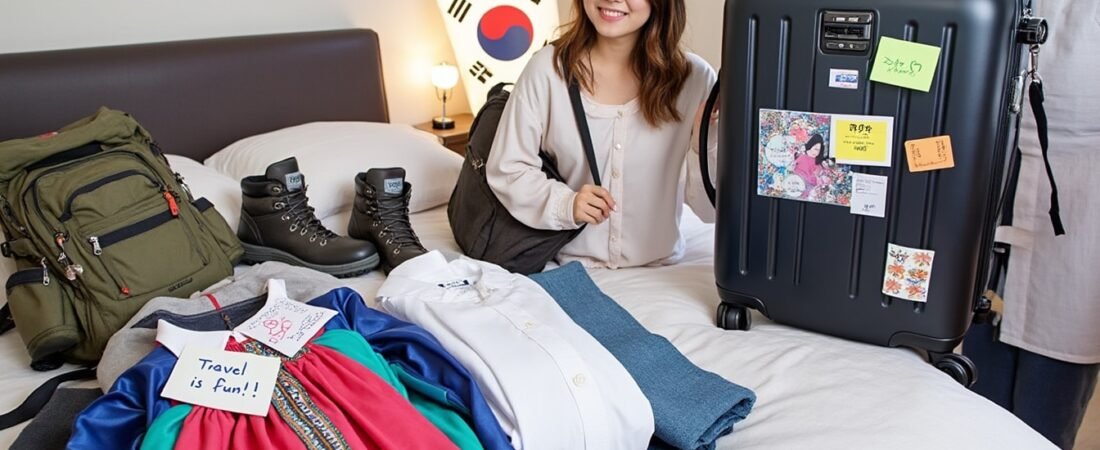
Quick answer: For a trip to South Korea, the things you really should pack are your passport and entry information, a phone with data, a 220V-compatible charger and Korea plug adapter, comfortable walking shoes, your prescription medication, at least one physical payment card, a small amount of backup cash, and season-appropriate clothing. Most basic toiletries, umbrellas and everyday supplies are easy to buy after you arrive.
The biggest packing mistake for Korea is not forgetting something—it is bringing too much. Seoul is one of the easiest cities in the world to replace ordinary travel items. Save your suitcase space for the things that are difficult, risky or annoying to replace.
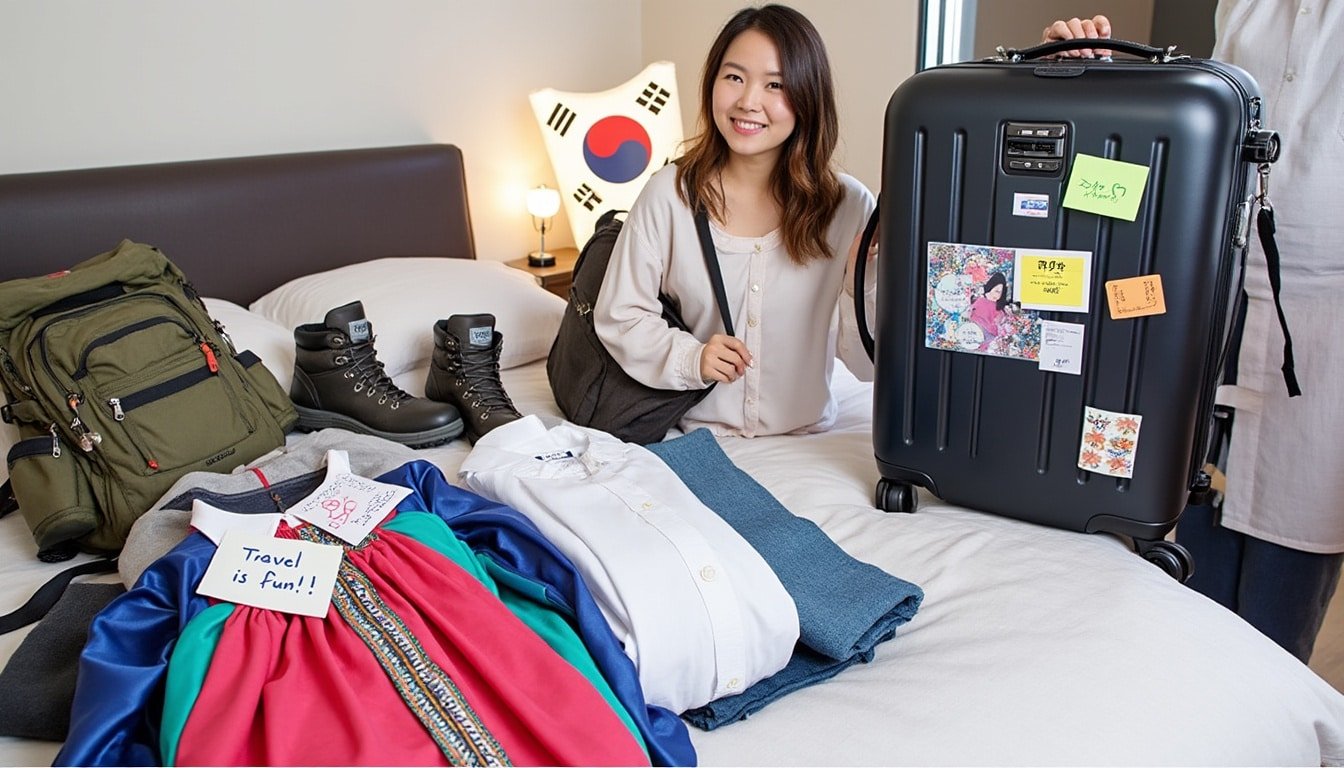
South Korea packing checklist: the 25 essentials
Documents: passport, required entry authorization/declaration, flight details, hotel address and travel insurance information.
Money: primary credit/debit card, backup physical card and some Korean won.
Tech: unlocked smartphone, charger, Korea-compatible plug adapter, charging cable, earbuds and a compliant portable battery.
Daily travel: comfortable walking shoes, light day bag, refillable bottle, tissues, any personal medication and season-specific clothing.
Useful extras: spare glasses/contact lenses, small laundry bag, compact shopping bag, sunscreen if you have a favorite formula, and a little empty suitcase space for shopping.
1. Passport and Korea entry documents
Your passport is the one item you cannot simply replace at a Seoul convenience store. Keep a digital copy stored separately and save your accommodation’s Korean address on your phone.
Korea now operates an official e-Arrival Card. The government states that eligible travelers can submit it online for free within three days before arrival. Whether you need an e-Arrival Card depends on your immigration status and whether you hold a valid visa, K-ETA or residence card, so use the official eligibility navigator rather than a third-party site.
If you are traveling on a U.S. passport, read KriMind’s 2026 K-ETA and e-Arrival Card Guide for Americans before departure.
2. Your phone—and data from the moment you land
Your phone becomes your map, translator, subway planner, restaurant finder, ticket wallet and camera in Korea. Arrange roaming, an eSIM or a physical SIM before or immediately after arrival. Korea Tourism Organization notes that major airports including Incheon have carrier roaming centers offering SIM cards and other connectivity services.
Download your key apps before the flight. KriMind’s Essential Korean Apps for Tourists covers navigation, translation and transportation, while the Naver Map Guide explains how to navigate without speaking Korean.
3. A Korea plug adapter
South Korea uses 220 volts at 60 Hz and outlets with two round holes. This is different from the standard plugs used in the United States. Bring a compact travel adapter compatible with Korean outlets.
An adapter only changes the plug shape. It does not automatically convert voltage. Check the tiny input label on your charger. Modern phone and laptop chargers often support a broad input range, but high-power appliances such as some hair tools may not.
4. Think twice before bringing a U.S. hair dryer or styling tool
This is where American travelers can make an expensive mistake. If an appliance is designed only for roughly 110–120V, plugging it into Korea’s 220V supply with a simple shape adapter can damage the device and create a safety risk.
Check for wording such as INPUT 100–240V. If your hair dryer, curling iron or other high-wattage tool is not dual voltage, use your hotel’s equipment or obtain a Korea-compatible device rather than relying on a tiny travel adapter.
5. Comfortable walking shoes
Korea trips involve more walking than many first-time visitors expect. Subway stations can be large, palace grounds are extensive, neighborhoods are hilly and a “five-minute transfer” can involve stairs and long corridors.
Bring shoes you have already broken in. A brand-new fashionable pair is a bad experiment for your first full day in Seoul.
6. Physical credit card plus a backup
Cards are widely useful in Korea, but do not travel with only a phone wallet. Bring at least one physical Visa or Mastercard-type payment card and preferably a second card stored separately. Foreign-card acceptance can vary by terminal and service.
Keep some Korean won as backup for situations where cash is easier or required. You do not need to carry a huge amount of cash every day.
7. Plan for a transportation card after arrival
You do not need to buy a T-money card in the United States. Transportation cards are available in Korea, including at major convenience-store chains. Once set up, they make buses and subways much easier.
See KriMind’s Korea Transportation Guide for T-money, subway, bus and taxi basics.
8. Portable battery—but know the 2026 flight rules
A power bank is extremely useful because navigation, translation, photos and mobile data can drain a phone quickly. But aviation rules changed significantly in 2026.
Korea’s Ministry of Land, Infrastructure and Transport announced strengthened rules effective April 20, 2026: portable batteries are limited under the applicable capacity/count rules, must remain with the passenger rather than in checked baggage, and using or charging a power bank during the flight is prohibited. Check your airline’s current policy before flying because capacity restrictions and approval requirements can also apply.
9. Prescription medication
Bring enough of your regular prescription medication for the trip and keep it in appropriate original packaging when possible. Do not assume that a medication sold over the counter in the U.S. has the same legal status or equivalent product in Korea.
If your medication contains a controlled or restricted substance, verify Korean import requirements before departure. Korea Customs warns that restricted goods can be confiscated and violations can be subject to Korean law.
10. Glasses, contacts and personal medical essentials
Bring spare glasses if you depend on them, enough contact lenses and any specific medical item that would disrupt your trip if lost. Korea has excellent pharmacies and optical stores, but replacing a personalized item wastes vacation time.
11. Pack for Korea’s season, not just “Asia”
Korea has genuinely distinct seasons. Your packing list should change dramatically depending on the month.
Spring: March to May
Bring layers: light jacket, sweaters or long sleeves, comfortable shoes and something warmer for cool mornings and evenings. Weather can change quickly during the transitional season.
Summer: June to August
Expect heat and humidity. Pack breathable clothing, sunscreen and footwear that can handle rain. A compact umbrella is useful, although it is also very easy to buy one in Korea.
Fall: September to November
Early fall can remain warm, while later autumn becomes much cooler. Layers and a light-to-medium jacket work better than packing only heavy winter clothes.
Winter: December to February
Bring a real warm coat, layers, gloves and cold-weather shoes. Do not assume Seoul has a mild East Asian winter simply because it is a major city.
12. A light day bag
You will probably leave your suitcase at the hotel and spend most of the day moving between neighborhoods. A small backpack or crossbody bag should hold your phone, battery, water, wallet and small purchases without becoming uncomfortable.
13. Leave room for shopping
This deserves a place on the packing list. If you plan to visit Olive Young, Korean fashion stores, convenience stores or souvenir shops, do not depart the U.S. with a suitcase packed to 100% capacity.
Korea’s tourist tax-refund system can also apply to qualifying purchases. KriMind’s Korea Tax Refund 2026 Guide explains the current ₩15,000 minimum and refund process.
What should you buy in Korea instead of packing?
Umbrella: easy to find at convenience stores and shops when rain arrives. Basic toiletries: shampoo, body wash, toothpaste and everyday personal-care items are widely available. Tissues and wet wipes: easy convenience-store purchases. Extra skincare: unless you need a specific medical or favorite product, Korea is not the place where you need to pack six backup moisturizers. Snacks and water: buy them locally.
KriMind’s Korean Convenience Store Guide explains what travelers can easily find after arrival.
What should Americans definitely bring from home?
Bring anything that is prescription-specific, fit-specific or personally irreplaceable: medication, prescription glasses, comfortable shoes you trust, specialized personal-care products, your preferred deodorant if you are particular about it, and clothing in sizes or fits that you know work for you.
Also bring the correct charging setup. Buying a cheap adapter after landing is possible, but discovering at midnight that your essential device is not compatible with 220V is avoidable.
Do you need a huge suitcase?
Usually not. Large luggage becomes annoying on station stairs, subway transfers and hotel changes. If you are visiting multiple Korean cities, being able to handle your own luggage comfortably is more valuable than having five extra outfits.
Seoul also has luggage lockers at many major subway stations, according to the city’s 2026 tourism guide. Packing lighter makes these services easier to use.
What not to pack for South Korea
Skip excessive toiletries, several “just in case” pairs of shoes, a giant umbrella, a week’s supply of snacks and bulky items you can cheaply buy after arrival. Avoid bringing electrical appliances that cannot safely handle 220V. And never put a portable power bank into checked luggage simply to save space in your carry-on.
The night-before-flight checklist
Confirm that your passport is in your personal bag, not your checked suitcase. Check your entry-document requirements. Save your hotel’s name, address and phone number. Activate or save your eSIM instructions. Download offline copies or screenshots of critical reservations. Check your airline’s battery policy. Charge your phone. Verify that your cards are available for overseas use. Finally, leave some suitcase space empty.
After landing at Incheon Airport
Once you clear immigration and customs, connect your phone, get cash if needed, arrange your transportation card and choose your route into Seoul. Do not automatically take the first transport option you see.
KriMind’s Incheon Airport to Seoul: AREX vs Airport Bus vs Taxi compares the main choices by hotel location and luggage.
Printable-style Korea packing checklist
☐ Passport
☐ Required Korea entry documents
☐ Hotel address and reservations
☐ Travel insurance information
☐ Phone
☐ eSIM/SIM/roaming plan
☐ Phone charger
☐ Korea-compatible plug adapter
☐ Compliant portable battery
☐ Physical credit/debit card
☐ Backup card
☐ Small cash reserve
☐ Prescription medication
☐ Glasses/contact-lens supplies
☐ Comfortable walking shoes
☐ Season-appropriate jacket
☐ Tops and bottoms you can rewear
☐ Underwear and socks
☐ Light day bag
☐ Personal toiletries you cannot easily substitute
☐ Sunscreen
☐ Reusable shopping bag
☐ Earbuds/headphones
☐ Charging cables
☐ Empty suitcase space for Korea shopping
FAQ
Do I need a power adapter for South Korea from the U.S.?
Yes. Korea uses 220V/60Hz outlets with two round holes. U.S. plugs generally need an adapter, and non-dual-voltage appliances may also require a proper voltage solution or should not be used.
Should I bring cash to Korea?
Bring or obtain a modest amount as backup, but you generally do not need to carry your entire travel budget in cash. Keep at least one physical payment card as well.
Should I buy T-money before going to Korea?
No. You can obtain a transportation card after arrival in Korea.
Can I pack a power bank in checked luggage?
No. Portable lithium batteries should not be placed in checked baggage. Korea also introduced stricter 2026 rules, including a prohibition on using or charging power banks during flights.
Do I need to bring toiletries to Korea?
Only the products you strongly prefer or medically need. Everyday toiletries are easy to buy in Korean convenience stores, supermarkets, pharmacies and beauty stores.
What is the most important thing people forget?
For U.S. travelers, the practical trio is often a Korea-compatible plug adapter, a reliable data plan and comfortable walking shoes. None is glamorous, but all three affect your trip every day.
Official sources
Republic of Korea — Official e-Arrival Card
Korea Tourism Organization — Electricity & Communications
Ministry of Land, Infrastructure and Transport — 2026 Portable Battery Flight Rules
Korea Tourism Organization — Prohibited & Restricted Items
Planning your first trip to Korea?
Subscribe for practical packing, airport, transportation, food, shopping and local Korea travel guides from KriMind.
Enter your email below to join KriMind.