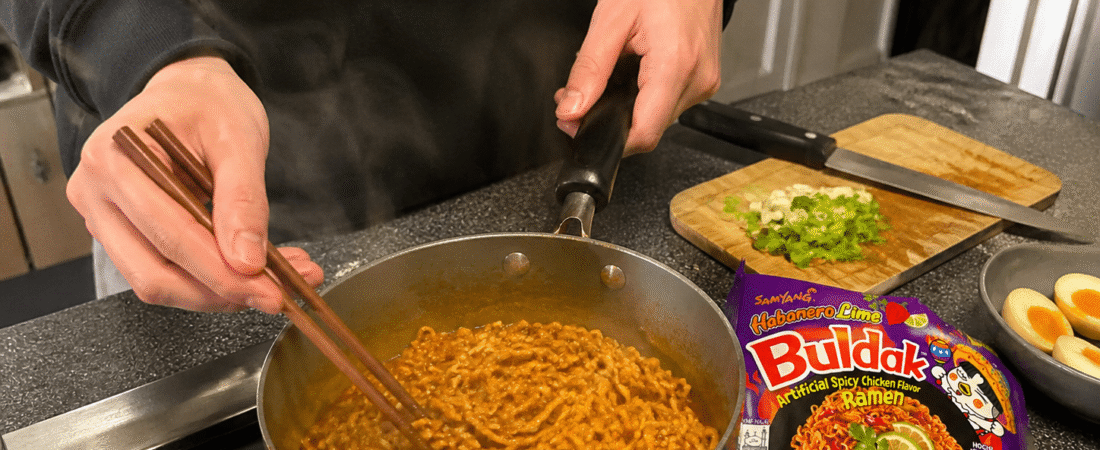
Quick answer: The best way to cook Buldak ramen is to follow the instructions for the exact flavor and format in your hand. For the current U.S. Original pouch, Samyang says to boil the noodles for 5 minutes, keep 1/2 cup (4 oz) of cooking water, add the sauce, stir-fry for 30 seconds, then add the flakes. But that is not a universal rule: Carbonara cups and bowls use different drainage instructions.
Buldak is easiest to ruin when you treat it like ordinary soup ramen. The goal is usually a glossy, concentrated sauce coating the noodles—not noodles swimming in broth.
After the noodles are cooked. For the U.S. Original pouch, cook the noodles first, drain most of the water while keeping about ½ cup, then add the liquid sauce and stir-fry for about 30 seconds. Do not pour the sauce into the full pot of boiling water like ordinary soup ramen.

The classic Buldak Original pouch method
| Step | Current U.S. Original pouch direction | Why it matters |
|---|---|---|
| 1 | Boil 2½ cups / 20 oz water | Enough water lets the noodles cook freely. |
| 2 | Add noodles; cook 5 minutes | Builds the intended chewy texture. |
| 3 | Keep ½ cup / 4 oz water; drain the rest | Controls sauce concentration. |
| 4 | Add sauce and stir-fry 30 seconds | Coats the noodles and reduces excess liquid. |
| 5 | Add flakes, mix and serve | Finishes the intended bowl. |
This is the baseline technique for Original according to Samyang America. It also explains why simply draining the noodles and squeezing sauce on top can taste different: the short stir-fry step is part of the official preparation.
Why Buldak cooking instructions are not all the same
Format changes the recipe. A pouch cooked on the stove has different heat, evaporation and drainage conditions from a cup or big bowl. Even Carbonara differs by market and package. The current U.S. Carbonara Big Bowl instructs the eater to drain all the water after four minutes before adding sauce and cheese powder, while Samyang America’s Carbonara pouch retains 1/2 cup of cooking water. Other regional cup versions specify retaining a few tablespoons.
That means the safest rule is simple: package instructions beat a generic TikTok recipe. Use hacks after you understand the intended baseline.
The 7 mistakes that ruin Buldak ramen
1. Treating Buldak like soup ramen
If you leave a full bowl of water and then add the sauce, you have diluted a concentrated stir-fry-style seasoning system. Unless you are intentionally making a Buldak soup recipe, the result will usually be weaker, thinner and less glossy than intended.
2. Draining every flavor and format the same way
“Always leave eight tablespoons” is not a universal Buldak rule. Original pouch, Carbonara pouch, Carbonara Big Bowl and other products can have different directions. Check the label before draining.
3. Overcooking the noodles before the sauce goes in
Remember that a stovetop pouch can receive additional heat while the sauce is mixed or stir-fried. If the noodles are already extremely soft before that stage, the finished bowl can become mushy.
4. Leaving a random puddle of water
Water is an ingredient here. Too much weakens seasoning and prevents the sauce from clinging; too little can make some powder-based flavors feel pasty or difficult to distribute. Measure when the package gives you a measurement.
5. Adding all your toppings before coating the noodles
First build the intended sauce-noodle emulsion. Then add egg, cheese, scallions, seaweed, kimchi or other toppings. Otherwise your toppings can absorb sauce unevenly while sections of noodle remain under-seasoned.
6. Assuming more sauce automatically means better Buldak
If you use bottled Buldak sauce on top of a fully seasoned packet, you are increasing salt, sweetness and heat together. Taste first. Add more only if you actually want a more concentrated bowl.
7. Letting it sit too long
Buldak sauce continues to thicken as the noodles cool and absorb moisture. The glossy texture you see immediately after mixing can become much tighter several minutes later. Finish the sauce and eat while hot.
How to make the sauce glossy instead of watery
Three variables matter most: correct retained water, thorough mixing and controlled heat. On a stovetop product that calls for stir-frying, keep the noodles moving while the sauce coats them. You want the liquid distributed across the noodle surface rather than pooled at the bottom.
For creamy flavors, powder needs to disperse completely. Add it according to the package directions and mix until no dry pockets remain. The starch carried by the noodles and retained cooking water helps bind the seasoning into a smoother coating.
How to cook Buldak Carbonara
Do not automatically copy Original’s method. Samyang America’s current Carbonara pouch directs you to boil the noodles for 5 minutes, retain 1/2 cup (4 oz) water, drain the rest, then add sauce and cheese powder and stir. The current U.S. Carbonara Big Bowl instead says to add boiling water to the inner line, wait 4 minutes, drain all the water, then add the sauce and cheese powder.
The apparent contradiction is exactly why format matters. Both can be correct for their respective products.
For the flavor itself, read Buldak Carbonara Explained.
Can you intentionally make Buldak as soup ramen?
Yes—but at that point you are making a variation, not following the standard dry-style method. Buldak’s official U.S. site itself published a 2026 Carbonara soup variation that deliberately keeps starchy noodle water and combines the sauce with egg yolk and mayonnaise to create an emulsified broth. The same feature also demonstrates rabokki and lo-mein adaptations.
That is a useful distinction: wrong water by accident creates a weak bowl; extra water used deliberately with a recipe creates a different dish.
When should you add cheese, egg or other toppings?
For most toppings, finish coating the noodles first. Then build on top:
- Fried or soft-boiled egg: add after saucing.
- Scallions and sesame: finish at the end for freshness and texture.
- Cheese: add while the noodles are still hot enough to melt it.
- Kimchi or pickled radish: serve alongside or add at the end so acidity stays distinct.
- Protein or vegetables: cook separately or ensure they are fully cooked before combining with the finished noodles.
See 12 Buldak toppings that actually improve the noodles for combinations by flavor.
How to control the spice without ruining the texture
If you are uncertain about your tolerance, reserve some of the liquid sauce before mixing rather than trying to rescue an unbearably hot bowl afterward. You can add more sauce, but you cannot remove it once it has coated every noodle.
Be aware that less sauce also means less seasoning, sweetness and umami. If you routinely use only a small fraction of the packet, a milder flavor may taste more balanced. Start with our Buldak heat guide or see how to make Buldak less spicy.
Best method by situation
| Your situation | Best approach |
|---|---|
| First time cooking Buldak | Follow the package exactly once before trying hacks. |
| Original pouch | Use the current Samyang stovetop method: cook, retain measured water, sauce, short stir-fry. |
| Carbonara pouch | Use its own retained-water instructions; mix sauce and powder thoroughly. |
| Carbonara Big Bowl | Follow the bowl directions rather than copying the pouch. |
| Want it less spicy | Reserve part of the sauce before mixing. |
| Want soup Buldak | Use a deliberate soup recipe rather than accidentally under-draining. |
| Adding toppings | Build the base sauce first, then finish the bowl. |
FAQ
Do you drain Buldak ramen?
Usually yes, but the amount you drain depends on the exact product. Original pouch retains measured cooking water; some bowl products instruct you to drain all water. Read your package.
Why is my Buldak ramen watery?
The most common reason is retaining more water than the format calls for. Insufficient mixing or skipping a required stovetop reduction can also leave liquid pooled at the bottom.
Why is my Buldak sauce too thick?
You may have drained too aggressively for that product, over-reduced the sauce, or let the finished noodles sit too long. Check the package’s retained-water instruction first.
Should I add the sauce while the noodles are boiling?
For standard Original pouch preparation, no: cook the noodles first, drain to the specified amount, then add sauce and stir-fry. Other recipes may intentionally use a different method.
Can I microwave Buldak?
Use microwave instructions only when your product packaging supports that method. Pouches designed around stovetop boiling should not automatically be treated like microwave cups.
What is the easiest Buldak to cook?
Cup and bowl formats are generally the most convenient because water level and timing are built around the container. For flavor selection, see Every Buldak Ramen Flavor Explained.
Sources & editorial note
Last checked: October 2, 2026. KriMind checked Samyang America’s current Original and Carbonara cooking directions, Buldak’s current U.S. Carbonara Big Bowl instructions, and Buldak’s May 2026 Carbonara recipe feature. Instructions can vary by flavor, market and format; the directions printed on your own package are the final reference.