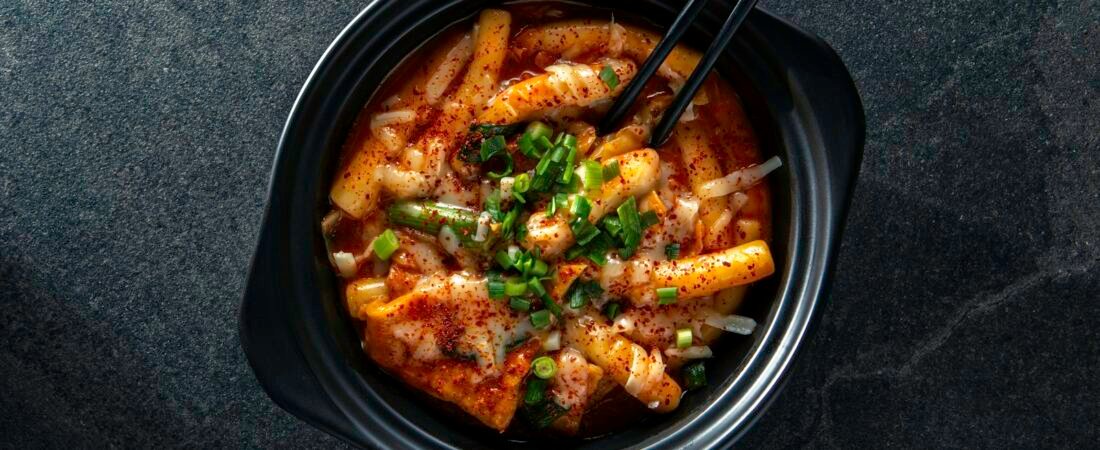
Tteokbokki (떡볶이) is one of Korea’s most famous street foods: chewy rice cakes simmered in a thick, usually sweet-spicy red sauce. If you are trying it for the first time, expect a texture closer to a very chewy noodle than bread, plus a sauce that can range from mildly sweet to genuinely hot depending on the shop.
The safest beginner order is classic tteokbokki with eomuk (fish cake), plus fried snacks or gimbap on the side. If you cannot handle spice, look for soy-sauce gungjung tteokbokki, jjajang tteokbokki or a mild rosé version instead.
What is tteokbokki?
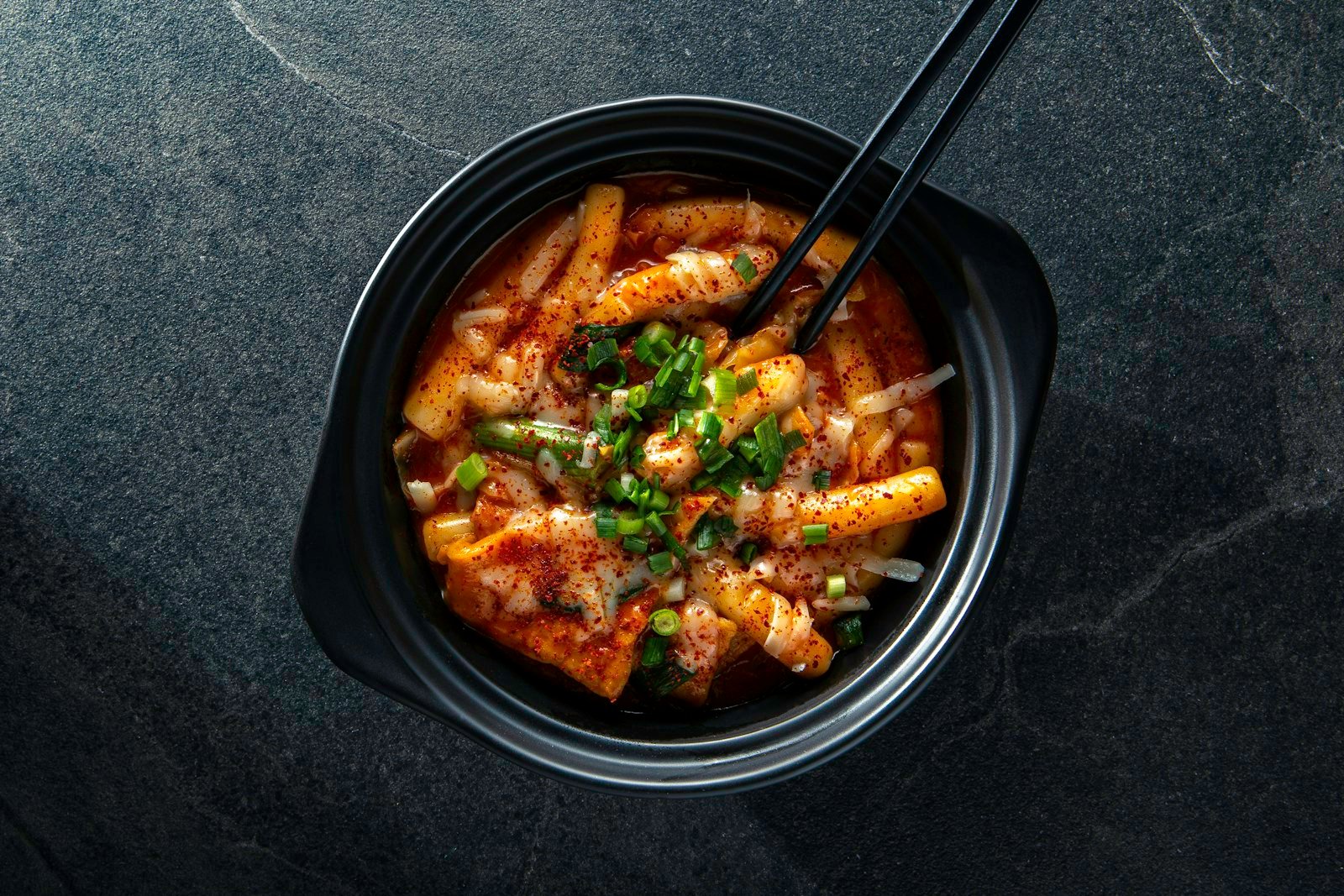
Tteokbokki is a Korean dish built around tteok, or rice cakes. The most familiar modern version uses long cylindrical rice cakes cooked with gochujang-based seasoning, vegetables and often thin sheets of fish cake.
The Korea Tourism Organization describes it as a representative spicy Korean food and one of the country’s most popular street foods. Cheese is a common modern addition, while a non-spicy version can be seasoned with soy sauce instead of red chili paste.
How do you pronounce tteokbokki?
For English speakers, a practical approximation is “duck-bo-kee.” The Korean spelling is 떡볶이. The first consonant is a tense Korean sound that does not map perfectly to English, so do not worry about producing a perfect Romanized pronunciation when ordering.
What does tteokbokki taste like?
Classic red tteokbokki is usually sweet, spicy, savory and slightly garlicky. The sauce becomes thick as the rice cakes cook, and fish cake adds another savory layer.
The biggest surprise for many first-time American visitors is not the flavor but the texture. Rice cakes are deliberately chewy. A good piece should have resistance when you bite it rather than dissolving like pasta.
Is tteokbokki spicy?
Usually yes, but there is no universal spice level. A traditional red street-stall version may be moderately or seriously hot, while a chain or modern café can offer mild, rosé, cream or black-bean-sauce options.
VisitKorea notes that the dominant style is sweet-spicy gochujang tteokbokki, while newer jjajang, cream and rosé varieties have become common. If you are sensitive to chile, never assume a bright-red tray is mild just because another shop’s version was easy.
Is tteokbokki hotter than Buldak ramen?
There is no reliable one-to-one comparison because both products come in different versions. Standard market tteokbokki is often easier for many people than the hottest Buldak varieties, but a deliberately spicy tteokbokki can still be intense.
If spice is your main concern, see KriMind’s Least Spicy Buldak Ramen Guide for another useful Korean spice reference.
What are tteokbokki rice cakes made of?
The key ingredient is tteok. Depending on the style and shop, tteokbokki can use rice-based cakes or wheat/flour-based cakes. VisitKorea notes that the two have different characteristics: wheat-based pieces absorb sauce well and remain firm, while rice-based cakes emphasize rice flavor and chewiness.
Why is tteokbokki so chewy?
That elasticity is intentional. Korean rice cakes are dense and compact, so the eating experience is fundamentally different from a flour noodle. The sauce coats the exterior while the center retains its chew.
If you dislike chewy textures, try a small portion before ordering a huge pot. If you enjoy mochi, udon or other elastic foods, the texture may be part of the appeal.
Does tteokbokki contain fish?
It often does. Thin eomuk fish-cake sheets are one of the most common additions, and broth or sauce can also contain seafood-derived ingredients. A bowl that appears to contain only rice cakes should not automatically be considered vegetarian.
Is tteokbokki vegetarian or vegan?
Not by default. Fish cake, anchovy-based stock and other animal ingredients can appear in traditional recipes. Vegan travelers should specifically look for a vegan version and confirm the stock and sauce rather than simply asking for the visible fish cake to be removed.
Is tteokbokki gluten-free?
Do not assume so. Some rice cakes may be rice-based, but sauces, soy sauce, fish cakes, processed ingredients and shared cooking equipment can introduce wheat or gluten. People with celiac disease should verify ingredients with the specific restaurant or packaged-food manufacturer.
Classic tteokbokki vs jeukseok tteokbokki
At a typical street stall, tteokbokki may simmer continuously on a large cooking surface and be ladled into a dish when ordered. Jeukseok tteokbokki (즉석떡볶이) is different: ingredients arrive in a pot and are cooked together for your table.
Sindang-dong in Seoul is famous for this made-to-order style. Pots can include fish cake, dumplings, glass noodles, ramen, vegetables, eggs and other add-ons.
Sindang-dong Tteokbokki Town
If you want to turn one snack into a Seoul food destination, Sindang-dong Tteokbokki Town is the obvious place. VisitKorea describes an alley roughly 100 meters long filled with tteokbokki restaurants and traces the area’s modern red-sauce tradition to Ma Bok-rim.
The attraction here is not merely eating rice cake from a cup. It is sitting around a large pan of jeukseok tteokbokki with noodles and extras, then often using the remaining sauce for fried rice.
Gungjung tteokbokki — the non-spicy ancestor
Red gochujang tteokbokki is the modern icon, but Korean culinary history includes gungjung tteokbokki, often translated as royal-court tteokbokki. It uses soy-based seasoning with ingredients such as vegetables and meat rather than the familiar fiery red sauce.
VisitKorea notes versions of the dish in late-Joseon-era recipe literature. For travelers who cannot eat spicy food, this is also proof that “tteokbokki” does not automatically mean chile heat.
Rosé tteokbokki
Rosé tteokbokki became a major modern variation by softening red tteokbokki sauce with creamy flavors. It is richer and often less aggressively hot than a classic version, although “rosé” does not guarantee zero spice.
Jjajang tteokbokki
Jjajang tteokbokki uses a dark black-bean-style sauce instead of the classic red gochujang profile. It can be a useful choice for someone who wants the rice-cake texture without a red chile-forward sauce.
Rabokki
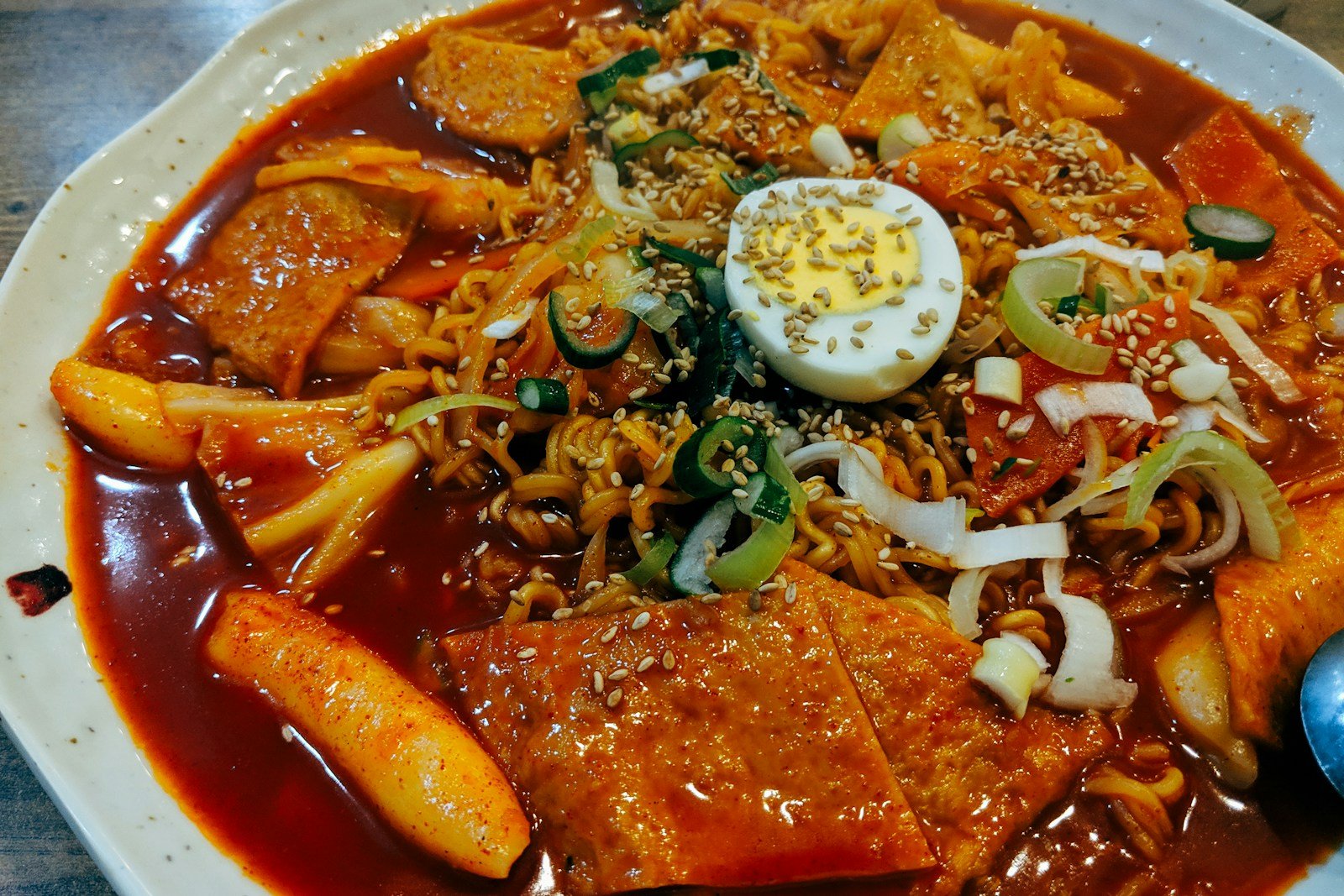
Rabokki = ramyeon + tteokbokki. Instant noodles cook in the tteokbokki sauce alongside rice cakes and other ingredients. It is heavier and more meal-like than a simple street portion.
Cheese tteokbokki
Cheese is one of the easiest ways to soften the perception of heat and add richness. Modern Korean bunsik shops frequently offer mozzarella or cheese toppings, and VisitKorea specifically notes cheese as a popular addition among younger diners.
Busan-style tteokbokki
Tteokbokki is not identical across Korea. VisitKorea highlights Busan versions that can use sliced radish to create a distinct broth and thicker sauce. Busan’s markets also let you combine tteokbokki with strong local eomuk culture.
If you are visiting Busan, areas around Bupyeong Kkangtong Market and BIFF Square are natural places to explore the city’s street-food variations.
Daegu tteokbokki
Regional variation also extends to Daegu, a city known for stronger spicy-food preferences. This is why asking “How spicy is tteokbokki?” without specifying the restaurant or region has no single numerical answer.
What should you eat with tteokbokki?
The classic combination is not tteokbokki alone. Add twigim (fried snacks), sundae (Korean blood sausage), eomuk and gimbap. Fried seaweed rolls, squid or dumplings dipped into the thick red sauce are especially good.
VisitKorea even describes the popular trio of tteokbokki + twigim + sundae as “tteok-twi-sun.”
How much does tteokbokki cost in Korea?
Prices depend on the neighborhood, restaurant and whether you order a small street portion or a large jeukseok set. Current VisitKorea listings illustrate the range: simple individual portions can be only several thousand won, while Sindang-dong table-cooked sets for two cost considerably more.
Use those numbers as context, not a permanent price list. Menus change. Always check the displayed menu when you visit.
Where to eat tteokbokki in Seoul
Sindang-dong is the destination for jeukseok tteokbokki. Traditional markets and neighborhood bunsik shops are better for the quick, everyday version. Gwangjang, Mangwon and other Seoul markets make it easy to combine rice cakes with several other Korean snacks.
If your goal is broader than one dish, use KriMind’s Korean Street Food Guide: 20 Must-Try Foods to build a full market tasting route.
How to order tteokbokki in Korean
떡볶이 하나 주세요. Tteokbokki hana juseyo. — One tteokbokki, please.
안 매운 거 있어요? An maeun geo isseoyo? — Do you have something not spicy?
이거 많이 매워요? Igeo mani maewoyo? — Is this very spicy?
튀김도 주세요. Twigim-do juseyo. — Fried snacks too, please.
Can tourists order it without speaking Korean?
Yes. Tteokbokki is visually easy to identify, and pointing to the tray or menu is normal. At modern chains you may encounter kiosks; at markets, simple Korean plus gestures is enough for most basic orders.
Use KriMind’s Naver Map Guide to find current branches and market locations in Korea.
Why Koreans are nostalgic about tteokbokki
Tteokbokki is closely connected to school-age memories. VisitKorea describes the familiar image of students stopping at inexpensive snack stalls after school and sharing tteokbokki with friends. That emotional role helps explain why it is more than a viral K-food.
For a visitor, a tiny neighborhood bunsik shop can therefore be more culturally revealing than an expensive “Korean cuisine experience” designed only for tourists.
Tteokbokki in K-pop and Korean culture
The dish’s international visibility has grown alongside the Korean Wave. VisitKorea specifically notes international interest and even points to BTS member Jimin’s social-media exposure as one moment that helped drive overseas interest in tteokbokki meal kits.
This is a useful GEO/AEO connection: searches for Korean food increasingly overlap with K-pop, K-drama and Korea travel rather than existing as isolated recipe searches.
Can you buy instant tteokbokki?
Yes. Korean convenience stores, supermarkets and online retailers sell cup, refrigerated, frozen and meal-kit versions. They are useful for learning the flavor, but a shelf-stable cup cannot perfectly reproduce rice cakes that have been simmering in a busy market sauce.
For more convenience-store foods to try, see KriMind’s Korean Convenience Store Guide.
What should a first-timer order?
For two people: get one classic tteokbokki, a few eomuk skewers and assorted twigim. Add gimbap if you want something mild between spicy bites. Do not order the largest portion until you know you like the chewy rice-cake texture.
Common mistakes tourists make
Assuming every tteokbokki is equally spicy: recipes vary enormously. Thinking the rice cake is a noodle: expect much more chew. Assuming it is vegetarian: fish cake and seafood-based stock are common. Eating only the rice cakes: the surrounding bunsik combinations are part of the experience. Going across Seoul for a viral shop without checking: verify hours and location before traveling.
FAQ
What is tteokbokki made of?
The classic modern version contains Korean rice cakes cooked in a sweet-spicy gochujang-based sauce, commonly with fish cake, green onion and other ingredients.
Is tteokbokki very spicy?
It can be, but spice varies by shop. Mild, soy-sauce, jjajang, cream and rosé versions also exist.
What does tteokbokki taste like?
Classic tteokbokki is sweet, spicy and savory with a thick sauce and very chewy rice cakes.
Is tteokbokki vegetarian?
Not automatically. Fish cake and seafood-based stock are common, so confirm the recipe if you follow a vegetarian or vegan diet.
Where should I try tteokbokki in Seoul?
Sindang-dong is famous for table-cooked jeukseok tteokbokki. Traditional markets and neighborhood bunsik shops are ideal for the everyday street-food style.
What is the difference between tteokbokki and rabokki?
Tteokbokki centers on rice cakes. Rabokki adds ramyeon noodles to the tteokbokki sauce and is generally a heavier meal.
Official sources
VisitKorea — Tteokbokki
VisitKorea — Korea’s Tteokbokki Road
VisitKorea — Street Food Loved by Koreans
Planning a food trip to Korea?
Subscribe for practical Korean food, markets, Seoul neighborhoods and local travel guides from KriMind.
Enter your email below to join KriMind.